About the Filmmakers

Andrei V. Golovnev
Andrei V. Golovnev took up the post of Director of Peter the Great Museum of Anthropology and Ethnography (the Kunstkamera) in June of 2017. He is a Professor with a Doctor of Sciences degree in history (with a specialization in ethnography) and a Member of the Russian Academy of Sciences. In 2020, he received the Russian Federation National Award in Science and Technology for his contribution to research into the cultural heritage of the Arctic indigenous peoples.
Professor Golovnev received his Candidate of Sciences degree in ethnography in 1986 at Moscow State University; his dissertation title was "Historical Forms of Economy Among Peoples in Northwest Siberia." He earned his Doctor of Sciences degree in 1995 at the Institute of Archaeology and Ethnography of the Russian Academy of Sciences, his dissertation title being "Samoyeds and Ugrians of Western Siberia: Complexes of Traditional Cultures."
Dr. Golovnev is known for his ethnographic films, which received awards at Russian and international film festivals, including the prize by the Arctic Studies Center at The Smithsonian Institution (1994) and Grand-Prix at the First and Second Russian Festivals of Anthropological Films (1998 and 2000). Since 2003, he has been President of the Russian Festival of Anthropological Films.
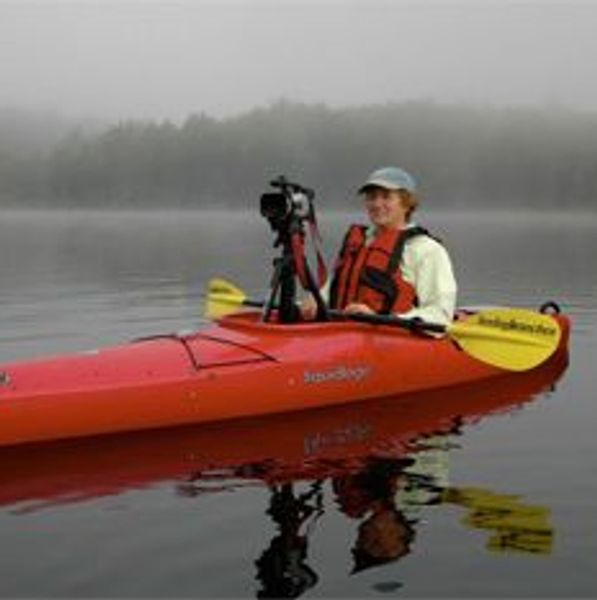
Gail Osherenko
Gail Osherenko filmed, produced, and narrated The Dark Side of the Loon in 2007-2008. She lives in Santa Barbara, California and watches loons in Vermont in the summer.
Film making combines her passion for film and photography with her background in environmental law and science. Her first film Arctic Expedition premiered at the SBIFF in 2007.
Now retired, she taught coastal and ocean law and policy at the University of California's Bren School of Environmental Science and Management. She holds a law degree from UC Davis, and worked as an environmental lawyer before moving to Vermont in 1981 and becoming immersed in Arctic studies. She studied and taught Arctic natural resources issues at the Center for Northern Studies in Vermont and at Dartmouth College in New Hampshire before relocating to Santa Barbara in 2003.
Gail's other films can be viewed at gailsfilms.com and steveschapel.com

Siberian Survival: The Nenets and Their Story
by Andrei V. Golovnev and Gail Osherenko
The Yamal Peninsula in northwestern Siberia is one of the few remaining places on earth where a nomadic people retain a traditional culture. Here in the tundra, the Nenets—one of the few indigenous minorities of the Russian North—follow a lifestyle shaped by the seasonal migrations of the reindeer they herd. For decades under Soviet rule, they weathered harsh policies designed to subjugate them. How the Nenets successfully resisted indoctrination from a powerful totalitarian state and how today they face new challenges to the survival of their culture—these are the subjects of this compelling and lavishly illustrated book.
The authors—one the head of a team of Russian ethnographers who have spent many seasons on the peninsula, the other an American attorney specializing in issues affecting the Arctic—introduce the rich culture of the Nenets. They recount how Soviet authorities attempted to restructure the native economy, by organizing herders into collectives and redistributing reindeer and pasture lands, as well as to eradicate the native belief system, by killing shamans and destroying sacred sites. Over the past century, the Nenets have also witnessed the piecemeal destruction of their fragile environment and the forced settlement of part of their population. To understand how this society has survived against all odds, the authors consider the unique strengths of the culture and the characteristics of the outside forces confronting it.
Today, the Yamal is known for a new reason: it is the site of one of the world's largest natural gas deposits. The authors discuss the dangers Russian and Western developers present to the Nenets people and recommend policies for land use which will help to preserve this remarkable culture.